

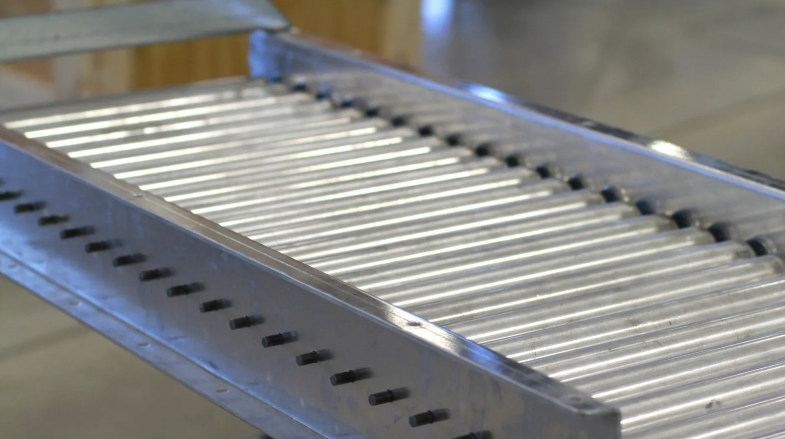
Warehouses look straightforward from the outside. Rows of shelves. Forklifts moving around. Boxes stacked high. But anyone who has spent real hours on the floor knows it’s not that simple. The challenge isn’t just storing products—it’s moving them efficiently. Fast enough to keep pace, but carefully enough to avoid chaos. That’s where a gravity roller conveyor comes in. At first, it seems almost too simple to matter. But in practice? It changes the entire flow of a facility. No motors. No electricity. Just motion, powered by gravity itself.
Why Gravity Roller Conveyors Are Different
Think of a gravity roller conveyor. Cylindrical rollers mounted inside a sturdy frame. An incline. Boxes, crates, or pallets gliding forward. Easy, right? But the magic happens in the small details. Roller spacing, surface friction, weight distribution—these all decide whether a package rolls smoothly or wobbles and stalls. It’s physics, yes, but also art. Operators who understand it can fine-tune movement. Adjust the angle slightly. Move a roller a fraction of an inch. Suddenly, flow improves dramatically.
And don’t confuse “passive” with “slow.” Just because a gravity conveyor lacks a motor doesn’t mean it can’t outperform powered systems in certain situations. With the right setup, throughput matches motorized lines—but without energy costs or constant maintenance. That subtlety is something most guides never mention.
Advantages That Aren’t Obvious
Simplicity is the first advantage. Fewer moving parts. Less can go wrong. But there’s more. Imagine a power outage. A motorized line stops completely. Chaos ensues. Packages pile up. Work halts. A gravity roller conveyor? It keeps moving. Boxes slide. Pallets glide. Production continues. That kind of reliability—quiet, unassuming—is invaluable.
Then there’s adaptability. Modular design allows conveyors to grow or shift as processes change. Need to reroute a section of the line? No rewiring. No tearing out motors. Just reconfigure the modules, adjust the incline, and you’re done. In real warehouses, layouts change constantly. People, orders, and priorities all shift. A gravity conveyor accommodates that naturally, almost organically.
Where They Truly Excel
Distribution centers, for example. Packages move from inspection to packing to shipping. Timing matters. Controlled flow matters. Powered conveyors sometimes overshoot or jam. Gravity conveyors handle this intuitively. Items slide at predictable speeds. No sudden surges. No collisions. In manufacturing, a similar pattern emerges. Parts arrive in batches. Workers need steady flow, not bursts. Gravity provides that naturally. Steady. Quiet. Reliable.
Retail warehouses benefit too. Imagine moving hundreds of boxes across a floor repeatedly. Manual labor is tiring. Risk of injury rises. Gravity conveyors reduce strain. They glide items to the right spot, letting staff focus on decisions and quality rather than repetitive lifting. Even small improvements like this add up—fewer injuries, lower fatigue, higher efficiency.
Integrating Gravity Conveyors with Modern Technology
Gravity conveyors may seem old-fashioned. Simple. Mechanical. But they aren’t disconnected from today’s tech. Sensors can detect when a box passes by. Automated sorters can redirect items at exactly the right moment. Some warehouses use scanners to log each package as it glides along. No electricity in the conveyor itself, yet the system communicates silently with software, tracking, organizing, and even prioritizing packages. It’s a blend of old-school physics and modern intelligence. Subtle. Efficient. Powerful—without the noise or energy draw of fully motorized systems.
Common Challenges and Lessons Learned
Not everything is straightforward. Many operators misjudge the incline. Too steep, and boxes “run away,” causing damage. Too shallow, and nothing moves without a push. Roller spacing matters as well. Too wide, and small packages get stuck. Too close, and maintenance becomes tedious. Material characteristics complicate things further. Cardboard, plastic, and wood all behave differently. Seasoned operators often combine gravity conveyors with targeted motorized sections for heavier or irregular loads. Small tweaks, big differences.
Conclusion:
The gravity roller conveyor may look modest. Almost invisible compared to motorized lines. But its impact is profound. It’s efficient, adaptable, and surprisingly resilient. Facilities that tune and integrate these conveyors carefully rarely revert to purely powered systems. They save energy, improve safety, maintain steady workflow, and keep operations moving smoothly. From light packages to heavy pallets, these conveyors demonstrate how simple physics, when understood and applied wisely, can transform a warehouse from chaotic to controlled. And in a world where every second counts, that makes all the difference.

